
On December 3, 2025, a draft regulation amending the Regulation on Tourist Accommodation (under the Tourist Accommodation Act, chapter H-1.01) was published in theOfficial Gazette of Quebec. This document, currently undergoing a 45-day consultation period before possible adoption by the government, proposes concrete changes that will have a direct impact on owners and managers of tourist accommodations in Quebec.

Enhanced proof of residence for primary rentals
For accommodations operated as a primary residence, the draft regulation now proposes that operators must provide two distinct proofs of residence to support their registration or renewal application.
This measure clearly aims to tighten controls and limit situations where a tourist residence is falsely declared as a primary residence to circumvent a more restrictive municipal regulation. By requiring credible and consistent documents, the government seeks to strengthen the credibility of the registration system and reduce the abuses observed in certain areas.
Specifically, this change should make it more difficult to artificially legalize non-compliant rentals, while protecting legitimate operators who truly meet the primary residence criteria. For property owners, this means increased vigilance regarding the documents submitted and an even greater emphasis on administrative compliance from the outset.
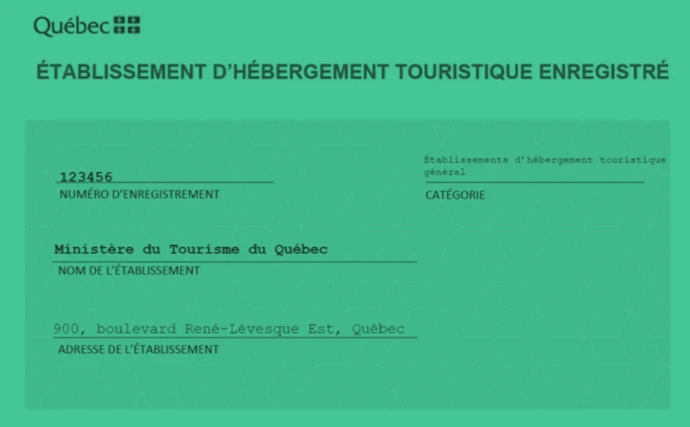
Change in registration number display obligations
Currently, operators of tourist accommodations are required to display the registration certificate in a publicly visible manner at the main entrance of the establishment. The proposed regulation aims to modify this requirement by specifying that the certificate must now be displayed in view of the tourist clientele.
This nuance, although subtle, introduces greater flexibility in the display requirements, particularly for certain types of properties where external display may be restrictive, inappropriate, or a source of conflict (condominiums, multi-family buildings, shared residences, etc.).
Specifically, this means that the certificate could be displayed inside the accommodation, in a clearly visible location for travelers (for example, at the main entrance or a common area), without necessarily needing to be visible from outside the building. This evolution allows for the maintenance of transparency towards the clientele while reducing the operational burden and practical issues for compliant operators.

Strengthening registration requirements
One of the major aspects of this regulatory project aims to strengthen the requirements applicable during the registration and renewal of a tourist accommodation establishment, particularly when the accommodation is located in a condominium or operated by a tenant.
This regulatory evolution reflects the government's desire to ensure better compliance of tourist rentals in more sensitive legal contexts, where the rights and responsibilities of the parties (co-owners, condominium associations, owners, and tenants) must be clearly established and respected.
However, these new requirements could pose an operational challenge for some operators. In practice, owners or tenant operators will not only need to obtain the initial authorization from the owner or the condominium association, but also provide a renewed confirmation letter on an annual basis to maintain their registration. This additional obligation increases the administrative burden and could complicate the renewal for accommodations whose authorization is conditional or evolves over time.
For the affected operators, rigorous anticipation and up-to-date documentation will become essential to avoid any interruption of registration or non-compliance situation.

Update of the registration number display in advertising
The draft regulation provides for a more explicit obligation regarding the display of the registration number in all promotional activities for a tourist accommodation. Operators will now be required to clearly indicate their registration number on all social media and advertising materials, without exception.
This measure aims to enhance transparency for travelers, facilitate compliance verification by booking platforms and authorities, and support adherence to applicable tax and tourism obligations. It also serves as a reminder of an existing requirement: any tourist rental of less than 31 days must be registered and display its registration number on listings, particularly on platforms like Airbnb or Vrbo.
The draft regulation, however, introduces some flexibility in certain contexts. When promotion is done verbally (for example, during a phone call or in person), or when it concerns multiple establishments at once, individual CITQ numbers may be replaced by the statement indicating that"the establishment is registered in accordance with the Tourist Accommodation Act (chapter H-1.01)".
This clarification aims to adapt display obligations to the realities on the ground while maintaining a high level of compliance and transparency.
Why are these changes important for owner-operators?
Taken together, these four regulatory adjustments mark a significant evolution of the short-term rental framework in Quebec. The strengthening of registration requirements and proof of primary residence aims to reduce instances of non-compliance and circumvention of municipal regulations, while protecting operators who operate legally. The new rules for displaying the certificate and registration number provide greater clarity and consistency for both travelers and booking platforms, while offering flexibility better suited to the operational realities of property owners. For operators, these changes involve increased administrative rigor, but also better long-term legal security: a well-documented, properly displayed, and compliant accommodation will be more resilient to inspections, complaints, and upcoming regulatory changes.
What is missing from the project, according to Lodixa
Although the draft regulation brings welcome improvements, some gray areas and structural issues remain unaddressed. From Lodixa's perspective, several key elements should have been clarified or better framed.
First, Lodixa welcomes the better regulation of primary residences, as it is widely recognized that many tourist residences are operated as "classic" short-term rentals while declaring themselves as primary residences to circumvent more restrictive municipal regulations or certain tax obligations. The strengthening of required proof is a step in the right direction and contributes to restoring fairer competition among operators.
However, the project does not provide any clarification regarding the municipal regulations applicable to primary residences. While several municipalities do not formally prohibit short-term rentals in primary residences, they sometimes regulate them so restrictively (quotas, maximum durations, conditional permits, heavy administrative requirements) that the legality and actual scope of these regulations raise important questions. Where is the line between legitimate regulation and a disguised prohibition? This question remains unanswered.
Finally, the project shows no willingness to standardize or harmonize the regulations and municipal taxes applicable to tourist accommodations. Certainly, it is understandable that realities differ between large urban centers and tourist regions. However, the complete absence of provincial guidelines allows for significant discrepancies from one municipality to another. Lodixa believes that non-binding provincial recommendations or guidelines could:
help municipalities better navigate when they wish to regulate or tax,
reduce regulatory arbitrariness,
and promote better predictability for owner-operators.
Today, some cities or municipalities impose restrictions and tax levels so high that operating a tourist accommodation becomes economically unviable, indirectly benefiting the hotel market. In a context of complementary tourist offerings, the burdens imposed on different types of accommodation should remain comparable and proportionate, in order to preserve a balanced and competitive tourist ecosystem.
Lodixa's Position: better framing, yes, but also clarifying, harmonizing, and balancing to ensure sustainable, fair, and economically realistic regulation.
In summary
The draft regulation published in the Official Gazette of Quebec proposes modifications to the regulatory framework for tourist accommodations in Quebec, including:
increased requirements during registration,
strengthened proof of residency,
modernized posting obligations,
and clarification of advertising obligations.
For owners and managers of tourist rentals, these changes will reduce the possibilities of circumventing regulations through the abusive use of primary residence status, clarify advertising requirements, simplify the posting of the CITQ certificate, while complicating the operation of tourist residences located in co-ownership.
These adjustments clearly move in the right direction towards a more balanced market, with a reduction in situations of unfair competition among operators. However, they remain insufficient as long as the main structural issue persists, namely the significant disparity in regulations and municipal tax levels, which still creates significant imbalances from one territory to another.