
Introduction
In the tourist accommodation sector, setting the right price at the right time has become a real challenge. Between seasonal variations, local events, changes in traveler behavior, and the constant evolution of competition, market conditions can change rapidly. A rate that seemed perfectly suited a few weeks ago may today be too high or, conversely, leave money on the table.
To address this reality, more and more owners and managers of tourist accommodations are turning to dynamic pricing. This approach involves adjusting prices based on market conditions to optimize both revenue and occupancy rates.
Although it is widely used in the hotel industry, air transport, or vehicle rental, dynamic pricing still raises several questions among short-term accommodation owners. Is it really effective? Does it allow for increased revenue? What are its risks? And above all, is it suitable for all types of properties?
In this article, we explore the main advantages of dynamic pricing, its limitations, as well as the best practices to adopt to make the most of it while maintaining control over your pricing strategy.
What is dynamic pricing?
A widely used practice
Although dynamic pricing is sometimes seen as a novelty in the tourism accommodation sector, it has actually been used for several decades in many industries. Its principle is simple: adjust prices based on changes in supply, demand, and market conditions to reflect the true value of a product or service at a given moment.
One of the most well-known examples is that of airlines. Two passengers sitting side by side on the same plane may have paid different prices depending on the booking date, travel period, or level of demand. The hotel industry has also been applying this approach for a long time, adjusting its rates according to seasons, local events, or expected occupancy rates.
Car rentals, cruises, shows, and even some online businesses today use similar strategies to adapt their prices to market conditions.
Short-term tourism accommodation is not exempt from this trend. With the growth of online booking platforms and access to a large volume of market data, owners now have tools that allow them to adjust their rates more accurately and responsively than before.
Dynamic pricing is therefore not an experimental method or reserved for large companies. It has become a common practice in many sectors where demand fluctuates constantly, and tourism accommodation is now part of these markets.
How does dynamic pricing work?
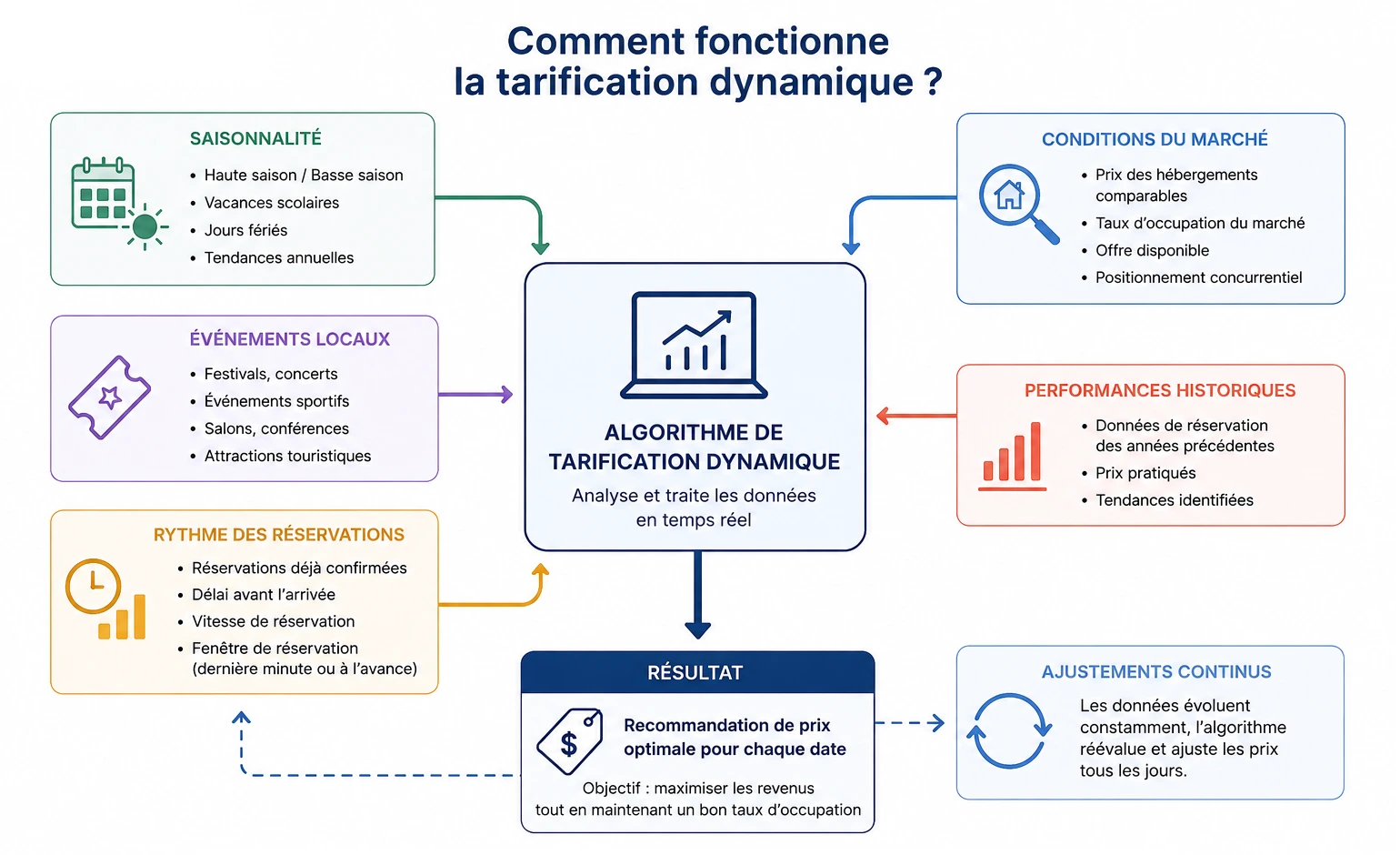
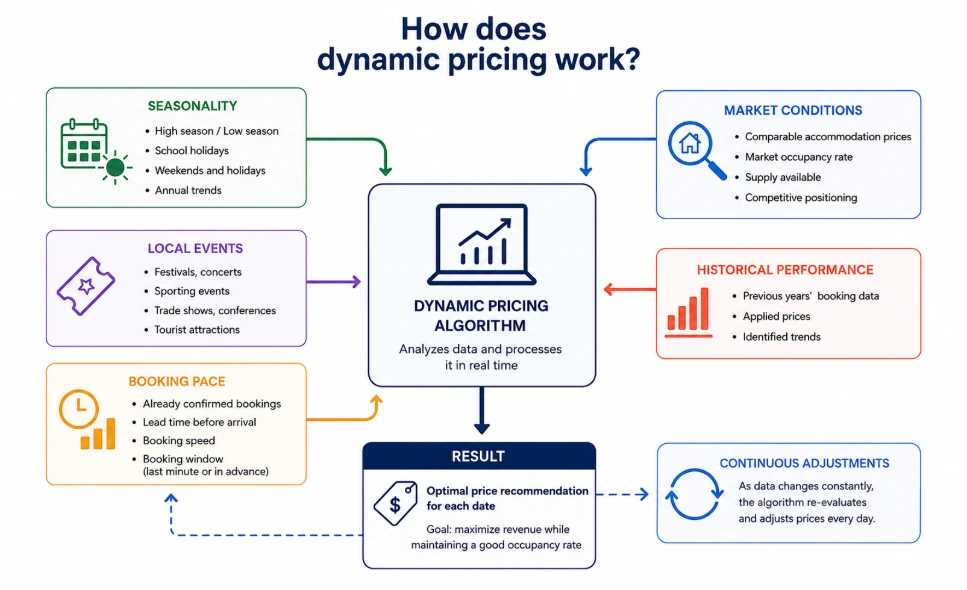
Unlike a fixed pricing strategy, dynamic pricing involves continuously adjusting rates based on market conditions. The goal is not simply to raise prices, but rather to offer a rate suitable for each night in order to maximize revenue while maintaining a satisfactory occupancy level.
To achieve this, dynamic pricing tools analyze a large amount of data and regularly reassess it. Among the most important factors are:
Seasonality
Demand naturally varies throughout the year. Holiday periods, public holidays, or tourist seasons generally generate stronger demand than off-peak periods.
Local events
A festival, a sporting event, a conference, or a major tourist activity can lead to a significant increase in demand in a given area. Dynamic pricing allows for price adjustments to take these opportunities into account.
The pace of bookings
The number of already confirmed bookings, the time before travelers' arrival, and the speed at which dates fill up are valuable indicators. Higher than expected demand may justify a gradual increase in rates, while a calendar that is slow to fill may require certain adjustments.
Market conditions
Specialized tools also analyze the prices charged by comparable accommodations in the same sector. This information helps assess whether a rate is competitive or if it should be adjusted based on the available supply.
Historical performance
Data from previous years can help identify traditionally strong or more difficult periods and anticipate booking trends.
However, it is important to understand that recommendations generated by software are only a starting point. The best results are generally achieved when market data is combined with a deep knowledge of the property, its clientele, and its objectives. Human oversight remains essential to validate adjustments and ensure that the pricing strategy remains consistent with the reality on the ground.
The benefits of dynamic pricing
When properly configured and supervised, dynamic pricing can offer several advantages to owners of tourist accommodations. Its main goal is to adjust prices to real market conditions in order to optimize the property's performance throughout the year.
Maximize revenue during periods of high demand
Certain periods naturally generate higher demand: school holidays, public holidays, festivals, sporting events, or tourist season. In these situations, maintaining a fixed rate can lead to lost revenue opportunities.
Dynamic pricing allows for gradual price adjustments as demand increases. The goal is not necessarily to charge the highest possible rate, but rather to ensure that the price reflects the true market value at any given time.
This approach often allows for better valuation of the most sought-after periods without necessarily affecting the occupancy rate.
Increase occupancy during quieter periods
Conversely, certain times of the year are more difficult to fill. A price that is too high can then discourage potential travelers and prolong vacant periods.
Dynamic pricing allows for price adjustments when demand is lower in order to maintain the property's attractiveness. A slight price reduction can sometimes be enough to generate more bookings and improve the occupancy rate.
For many owners, the goal is to find the best balance between the price obtained and the number of nights booked.
Quickly adapt to market fluctuations
The tourism accommodation market is constantly evolving. A last-minute announced event, a change in booking habits, or a shift in local supply can influence demand in just a few days.
Dynamic pricing allows for quicker reactions to these changes than traditional pricing management methods. Adjustments are made based on available data, which helps maintain a strategy consistent with the actual market conditions.
This adaptability is particularly useful in destinations where demand varies greatly from week to week.
Reduce the time spent on price management
Manually managing the rates of an accommodation can quickly become complex. It is necessary to monitor local events, analyze the competition, check occupancy rates, and regularly update booking calendars.
Dynamic pricing tools automate much of this analytical work and provide continuous adjustments. The owner no longer needs to individually review each date on their calendar.
Even though supervision is still recommended, this automation generally allows for a significant reduction in the time spent on pricing management.
Relying on data rather than intuition
Pricing often relies on personal experience, habits, or one-off comparisons with a few competitors. While these elements remain useful, they do not always provide a complete view of the market.
Dynamic pricing relies on a large amount of data: booking trends, traveler behavior, local events, performance history, and market conditions.
This approach allows for decisions to be made more based on objective information than on assumptions. Owners thus have a better understanding of their competitive environment and can adjust their strategy with more confidence.
The disadvantages and limitations of dynamic pricing
Despite its many advantages, dynamic pricing is not a perfect solution. Like any management tool, its effectiveness depends on the quality of the data used, the chosen configuration, and the monitoring done by the owner or their manager.
Understanding its limitations allows for realistic expectations and the implementation of a more effective long-term strategy.
A poor configuration can reduce revenue.
Dynamic pricing tools operate based on parameters set by the user. If the minimum or maximum prices are poorly established, the recommendations can yield disappointing results.
A minimum price that is too low can unnecessarily reduce revenue during less busy periods, while a maximum price that is too restrictive can prevent fully capitalizing on high-demand periods.
Conversely, prices that are too high can also have negative consequences. When a traveler feels that the price paid does not match the quality, amenities, or experience offered by the accommodation, their level of satisfaction may decrease. This situation can result in less favorable ratings, negative comments, or a decline in recommendations, which can affect the property's long-term performance.
The goal of an effective pricing strategy is therefore not simply to achieve the highest possible price, but rather to find the right balance between profitability, competitiveness, and traveler satisfaction.
The tools do not know all the specifics of your property
Even the best algorithms cannot always account for the unique characteristics of an accommodation.
An exceptional view, recent renovations, distinctive amenities, a particularly strong reputation, or conversely, certain local disadvantages can influence the actual value of a property without being fully reflected in the analyzed data.
Human interpretation remains important to adjust recommendations when the reality on the ground differs from statistical models.
Market data is not always perfect
Dynamic pricing systems rely on data from various sources. Although this data is generally reliable, it is never 100% complete.
Some accommodations may not be included in the analyses, some trends may evolve quickly, and some local events may be detected with a certain delay.
The generated recommendations should therefore be considered as a decision-making aid rather than an absolute truth.
Unsupervised automation carries risks
One of the most common mistakes is to activate a dynamic pricing tool and then stop monitoring the evolution of the results.
Even when adjustments are automated, it remains essential to monitor performance, bookings, and market evolution. Significant changes in competition or demand may sometimes require strategic adjustments that the algorithm cannot anticipate alone.
Technology is an excellent decision-making aid, but it does not completely replace human expertise.
Some owners prioritize price stability
Dynamic pricing means that prices can vary regularly throughout the year. This reality does not necessarily suit all owners.
Some prefer to maintain a simple and predictable pricing structure, especially when they use their property at certain times or when they prefer minimal management.
In these situations, the potential benefits of dynamic pricing may be less significant than the simplicity offered by a more stable pricing strategy.
Not all dynamic pricing tools are created equal
Today, there are several dynamic pricing solutions on the market. Some prioritize ease of use, while others offer a much more advanced level of customization.
In general, the more precise a tool is and the more it allows for fine control over the parameters influencing prices, the more complex its configuration and use become. Minimum and maximum prices, adjustments according to seasons, events, booking lead times, automatic opening of orphan nights, length of stays, or revenue goals are all elements that can influence the results.
Without a proper understanding of how these tools work, it is possible to achieve performance below expectations. Poor configuration can limit potential revenue, reduce occupancy rates, or generate recommendations that do not align with the owner's goals.
Dynamic pricing is therefore an area where human expertise remains an important factor for success. The tools provide data and recommendations, but their effectiveness largely depends on the quality of the parameters provided to them and the ongoing monitoring over time.
Delegating management to specialists
For owners who wish to benefit from the advantages of dynamic pricing without having to master all the tools and parameters, it is possible to entrust this responsibility to specialists.
At Lodixa, our dynamic pricing management service allows owners to delegate this task to an experienced team that masters the main market tools and best pricing management practices. We ensure the initial setup, continuous performance monitoring, and necessary strategic adjustments to maintain pricing suited to market conditions.
This approach allows owners to benefit from expertise, data, and cutting-edge technologies while retaining control of their property and business objectives.
In summary
Dynamic pricing is a powerful tool, but it should not be considered a fully autonomous solution. The best results are generally achieved when market data, technological tools, and the experience of the owner or their manager work together.
The goal is not to fully delegate the pricing strategy to an algorithm, but rather to use it to make better-informed decisions.
Best practices for success
Dynamic pricing can yield excellent results when used thoughtfully. However, like any optimization tool, its effectiveness depends on the strategy implemented and the monitoring carried out over time.
Here are some best practices that generally lead to the best results.
Set realistic minimum and maximum prices
Minimum and maximum prices form the foundation of any dynamic pricing strategy.
A minimum price that is too low can lead to unnecessary revenue decreases, while an unrealistic maximum price risks hindering bookings and harming the perceived value of the accommodation.
These limits must take into account several factors:
- The quality of the accommodation
- The amenities offered
- The location
- The operating costs
- The desired market positioning
A periodic review of these parameters is also recommended in order to keep up with market changes.
Adapt the strategy to its objectives
Not all owners pursue the same objectives. An effective strategy must be tailored to the reality of each property.
Maximize revenue
Some owners primarily seek to generate the highest possible revenue. In this case, the strategy will generally aim to fully capitalize on periods of high demand, even if this sometimes involves a slight decrease in occupancy rates.
Maximize occupancy
Other owners prefer to maintain a schedule that is as full as possible. The strategy will then favor a price level that encourages more bookings.
Find a balance between the two
In most cases, the goal is to find the best compromise between revenue and occupancy in order to optimize the overall profitability of the accommodation.
Regularly review performance
Even when an automated system is used, it remains important to track the results obtained.
The regular analysis of performance indicators allows for the verification of :
- The occupancy rate
- The generated revenue
- The average revenue per night
- The booking lead times
- The evolution of local competition
This approach allows for the quick identification of necessary adjustments and the continuous improvement of the strategy.
Combine technology and human expertise
Dynamic pricing tools are capable of analyzing an impressive volume of data, but they do not completely replace human expertise.
The owner or their manager often has information that algorithms cannot know :
- Recent works
- New equipment
- Customer specifics
- Unlisted local events
- Changes in the local market
The best performances are generally achieved when data and on-the-ground experience work together.
Do not seek to systematically copy competitors
It may be tempting to align your prices with those of neighboring accommodations. However, two properties located in the same area can have very different clientele, amenities, quality levels, and experiences offered.
Several studies show that price is not systematically the main selection criterion for accommodation. Travelers often place more importance on elements such as cleanliness, the perceived quality of the accommodation, the safety of the area, the location, and the reviews left by previous visitors. In a study published in 2024, cleanliness, the feeling of safety, and location were among the most important criteria when choosing tourist accommodation, ahead of several other factors including the cost of the stay.
Systematically seeking to be cheaper than competitors is therefore not always the best strategy. In many cases, travelers are willing to pay more for accommodation that better meets their expectations and offers a better overall experience.
The goal is not to have the lowest or the highest price, but the price that best matches the real value offered to travelers.
Is dynamic pricing suitable for your accommodation?
Dynamic pricing can be a powerful lever to improve the performance of tourist accommodation, but it is not necessarily the ideal solution for all owners or for all properties.
Its effectiveness particularly depends on the market in which the accommodation is located, the level of competition, the seasonality of the destination, and the objectives pursued by the owner.
Situations where it is particularly effective
Dynamic pricing tends to produce the best results in markets where demand fluctuates regularly throughout the year.
It is particularly suitable for:
- Accommodations located in popular tourist destinations ;
- Properties subject to high seasonality ;
- Accommodations located near major events or attractions ;
- Markets where competitive supply is significant ;
- Owners looking to actively optimize their income.
In these contexts, demand variations can be significant from week to week, or even from day to day. A dynamic pricing strategy allows for better leveraging of high-demand periods while remaining competitive when the market slows down.
Situations where profits may be more limited
Conversely, some accommodations may derive a more moderate benefit from dynamic pricing.
For example :
- Properties located in areas where demand remains relatively stable throughout the year ;
- Accommodations primarily receiving recurring or long-term bookings ;
- Owners who prefer very simple management with few interventions ;
- Markets where competitive supply is limited.
In these situations, a simpler pricing strategy can sometimes yield satisfactory results with less management effort.
Questions to ask before adopting dynamic pricing
Before implementing a dynamic pricing strategy, it may be helpful to ask a few questions :
- Does my market experience significant demand variations throughout the year ?
- Are my rates regularly reviewed today ?
- Do I have the time and knowledge necessary to set up and monitor the performance of a dynamic pricing tool?
- Do I want to maximize my revenue, my occupancy rate, or a balance between the two?
- Does my accommodation stand out enough to justify higher rates than some competitors?
The answers to these questions often help determine whether dynamic pricing represents an interesting opportunity or if a simpler approach might be sufficient.
Conclusion
Dynamic pricing is not a magic solution, but it has become an essential tool for many owners of tourist accommodations looking to optimize their revenue and occupancy rate. When well configured and tailored to the owner's objectives, it allows for better responses to market fluctuations while maintaining a consistent pricing strategy.
However, the best results are generally not achieved by automation alone. Effective pricing relies on a combination of market data, specialized tools, and human expertise. The quality of the accommodation, the experience offered to travelers, the property's reputation, and the specifics of the local market remain essential factors that cannot be entirely entrusted to an algorithm.
For owners who wish to benefit from the advantages of dynamic pricing without having to master the complexity of the tools or dedicate time to their daily management, Lodixa offers a dynamic pricing management service tailored to the realities of tourist accommodation.
Our team ensures:
- The analysis of your market and your property ;
- The customized configuration of pricing tools ;
- The continuous monitoring of performance ;
- The human supervision of pricing adjustments ;
- Periodic reports and recommendations.
You thus benefit from a personalized and optimized pricing strategy while maintaining control of your property and your objectives.